

Ma Rainey's Black Bottom
Round House Theatre
PreviewsSep 9, 2026
OpensSep 16, 2026
ClosesOct 18, 2026
MarylandPlayPublished on September 25, 2026
An electrifying and richly layered production of August Wilson's classic that darkly depicts the soul of creation and the grit of ambition.
Book10/ 10
Quality of the script and book
Acting10/ 10
Strength and consistency of performances across the cast
Production10/ 10
Direction, choreography, and technical stagecraft
Viz8/ 10
The marketing, identity, and visual development of the specific production
Intro
That makes three: of all of August Wilson's Pittsburgh Cycle, the series of 10 loosely-interconnected plays that chronicle the 20th century Black experience, I had only seen two. The first was Radio Golf, at Round House a few seasons ago. The second, Joe Turner's Come and Gone, I checked out in Chicago in 2024. My third combines the two: Round House, in collaboration with Olney Theatre Center, is kicking their season off with Ma Rainey's Black Bottom, the only one of Wilson's cycle not set in Pittsburgh -- but instead, in Chicago. And Chicago has seemingly come along for the ride, as both Ma's actress Nicole Michelle Haskins and director Lili-Anne Brown have major Windy City roots. But there's a ton of local talent attached here, make no mistake -- and the synergy between all of them has begotten an explosive, insightful, and ultimately chilling theatrical experience that sets the bar for this season's dramatic offerings impossibly high.
Book
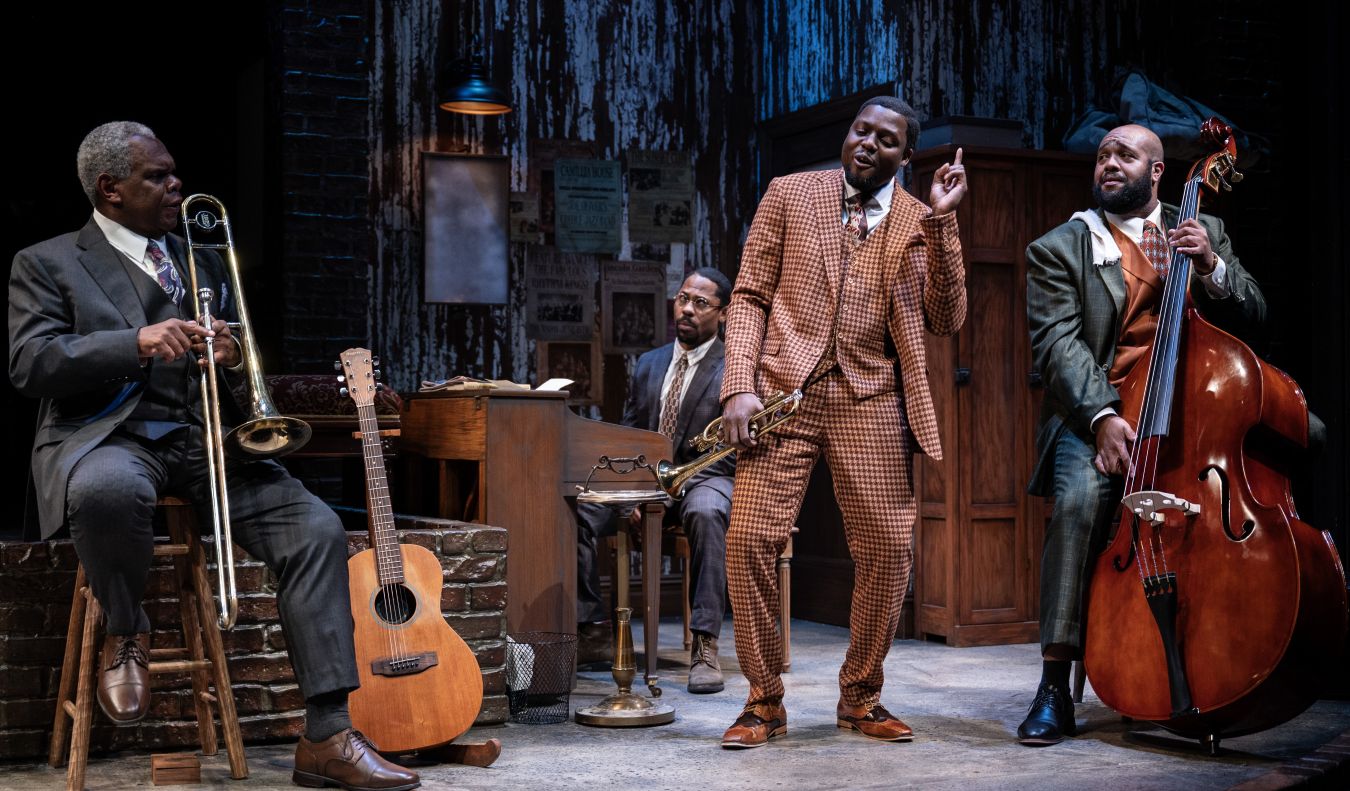
I think this might be my favorite of the Pittsburgh Cycle so far. This entry, set in a 1920's recording studio, follows the recording session of Ma Rainey, the Mother of the Blues, and more specifically the inter workings of her band. They arrive first, and are shuttled to a rehearsal room out of sight of the producer and Ma's manager (both white). As they prepare, we get to explore the personalities of the quartet: the jovial bassist Slow Rag, the stern and pious trombonist Cutler, the jagged intellectual Toledo on keys, and the ambitious go-getting trumpeter Levee. Wilson's famous metaphors get a ton of use with these, as each are representative of core facets of the Black experience, often described directly, as much as they are deep characters with hilarious interpersonal diatribe. Toledo's brain is likened to that of Booker T. Washington in how he advocates for literacy and education as a means of power; Levee, for example, butts heads with him on this as his embrace of self-starting capitalism is what drives him, going so far as to riff on Ma's songs and write his own to reach stardom on his own. Cutler and especially Slow Rag get the shorter end of the sticks in their symbolism over the two-act course, but are not "wasted" by any means, especially in Act II when Cutler splays his personality in junction with his faith, another foundational Black cornerstone. In fact for much of Act I, these fellas are all we get: it's a sort of Waiting for Ma that teeters on being a play where "nothing happens", just some guys learning how thinking works.
But then Ma arrives, and you can practically see her health bar appear on stage like a video game boss. Her impact is immediate and visceral, and her demanding demeanor foundationally shifts the tone of the piece from philosophical thumb-twiddling to the exploration of power within and between the marginalized and not-. Her mere presence introduces several more layers of thought into what was already a very thinky piece: ableism, queerness, and even police relations. It turns what was a cooler, Blacker, Stereophonic into a scene of instant notoriety as how Ma contorts the dynamic of that recording studio. But she's not an "Angry Black Woman" as such expressions of rage often evoke: she is just as complex and driven as any character on there, if not more. Her posse, too, such as her stuttering nephew Sylvester and "groupie" Dussie Mae, all represent unique facets of Ma that fling themselves into the world of the play outside of her immediate orbit but still carry traces of her magnanimity. The show's characters are kaleidoscopic in their envisioning of the Black experience, reverberating sociocultural frequencies felt even today. Even as the show ends on a downer -- as Wilson's plays often do -- you can't help but feel the symbolism and rich thought that Black Bottom brings to the table. In all of the sorrow and tragedy depicted in the play, there's still hope to be had in the Black American experience. After all, ain't that what the Blues are all about?10/10
Acting
When I invited my plus-one to my performance, I warned them that there would be "capital-A" Acting in this production. I mean, when a marquee features this many multi-Helen Hayes winning actors (Craig Wallace, Yao Dogbe, Ro Boddie, and Derrick Truby), under the auspices of a recent Helen Hayes-winning director in Brown (for Olney's Fela! in 2023), it's hard not to expect that sort of thing, no matter how low you try to set expectations. Yet no matter how high mine inevitably got, they were surpassed bar none by an ensemble of impeccable skill and dangerously astute presence. Particularly, the interplay between Boddie (Toledo) and Dogbe (Levee) was incredible as diametric poles in the evolution of Black respectability of the era. Additionally, Ma is embodied by a dominating Nicole Michelle Haskins: she is authoritative and uncompromising, a lynchpin of musical power that knows her worth. (She can sing, too.) Her alarming entrances are foiled by her softer concern for her community, such as her regards for her nephew Sylvester (a collected performance by Jaylen Henderson). It's an ensemble of the utmost quality, living up to the cosmically-sized shoes to fill in a show with intangible profundity. 10/10
Production
Wilson's script is already layered beyond belief, stuffing so much conversation and ideology into a single play. It doesn't feel like you need to do much to improve that, and trying could work out poorly, unless you're a particularly good director.
Lili-Anne Brown is a particularly good director.
Her production is one I am still thinking about as I write this review three days after walking out of the theatre. Let's start with the set: Arnel Sancianco's tri (!)-level staging is stupendously effective. The show's commentary on the dynamics of power within entertainment from a Black lens are vividly represented by how the production is split. The band -- who make up much of the sound but are overlooked by the audience and the producers-- are most often delegated to a small, narrow basement area, seldomly moving to the larger middle tier. Ma and ger posse tends to spend most of her time in this region, representing her elevation in status above her Black peers. These levels are relatively close together, connected by a small hallway staircase, unlike the producer's booth, which monitors the performers like overseers via a tall onstage staircase. (It's likely no mistake that no Black character ever goes near this staircase the entire show, much less enters the production booth at the top.) These divisions in class are represented too by the amazing costumes by Samantha C. Jones, which range between ornate flappery gowns and luxe fur coats to beat-up work boots that barely fit in with professional jazz suits, all lit up to dramatically chilling effect by Minjoo Kim's lighting.10/10
Visual Identity
The key art that Olney and Round House are using seems too busy for a cool-and-collected show like this, using radial glitch effects on top of a Ma Rainey jazz session. The busyness doesn't help having used a bright green-pink palette for it. As for the audience, the space is set up as the studio from the get-go, allowing one to investigate the level of detail and wear in the space immediately. The dimmed, pointed lighting makes for a more somber entrance.8/10
Overall
38/40

