

Venus
Woolly Mammoth
PreviewsSep 10, 2026
OpensSep 14, 2026
ClosesOct 4, 2026
DCPlayPublished on September 16, 2026
Weird, dark, and often obtuse, but ultimately a thrilling drive-by for the worst first date of all time.
Book5/ 10
Quality of the script and book
Acting9/ 10
Strength and consistency of performances across the cast
Production9/ 10
Direction, choreography, and technical stagecraft
Viz8/ 10
The marketing, identity, and visual development of the specific production
How to get there:
Woolly Mammoth
Archives-Navy Mem'lGYD10D1XD24D30D40CaBi♿
641 D St NW, Washington, DC 20004
Intro
I think Woolly is back, guys. Like, back-back.
After the last season-and-a-half of largely, understandably, directionless programming, the famed Penn Quarter house recruited a new Artistic Director in Reggie D. White (writer of Fremont Ave.) and has built its 26-27 season around the thing it's known best for. That's right: weird-ass plays. In Venus, the company's season-opening world premiere directed by White, that ethos that has come to define this company has made a triumphant return via his smart directorial touch and two performances that are at the same time funny, perplexing, and simply crazy. Just how we like it.
Book
It's hard to write a two-handed piece, especially about a first date; in my experience, the characters tend to devolve into self-inserts by the playwright, or worse, are overcorrected to not seeming like actual human beings. Playwright Steve Yockey does, luckily, avoid this pitfall with naturally-sounding characters who are both neurotic in their own fun ways, but the energy still veers off into abstraction, which is where the piece sags a bit. The plot follows Beth and Nicole, two women who meet at a book club and proceed to go on a first date for the history books. (Right alongside the war crime biographies). Beth is a rambunctious, dudey lovebomber with no filter, and Nicole is a straight-laced, whatever-is-above-Type-A librarian with meticulously crafted dating profiles and a well-loved pet fish. The show is presented as the two of them combatively narrating the events of that night to the audience directly. It's often, surprisingly so, quite humorous, eliciting plenty of laughs along the ride. But the snags come with how they try to expand this into something more cerebral, via interspersed rabbit holes of thoughts, (impressively delivered) monologues, and the appearance of mysterious unseen figures. They never feel resolved, as if they were intended to have the audience complete their story for them. The resolution we do get is certainly an interesting one, but deflated compared to the electric potential we receive from the pair for most of the 100-minute runtime.5/10
Acting
The two-hander gets said appendages through its marvelous leads, Kimberly Gilbert and Regina Aquino. This being a much funnier show than expected, it creates particularly fertile ground for Gilbert to flex her range in acting. The level of physical humor alongside the dialogue, especially in tandem with the more straight-laced Aquino, makes for an engaging pair.9/10
Production
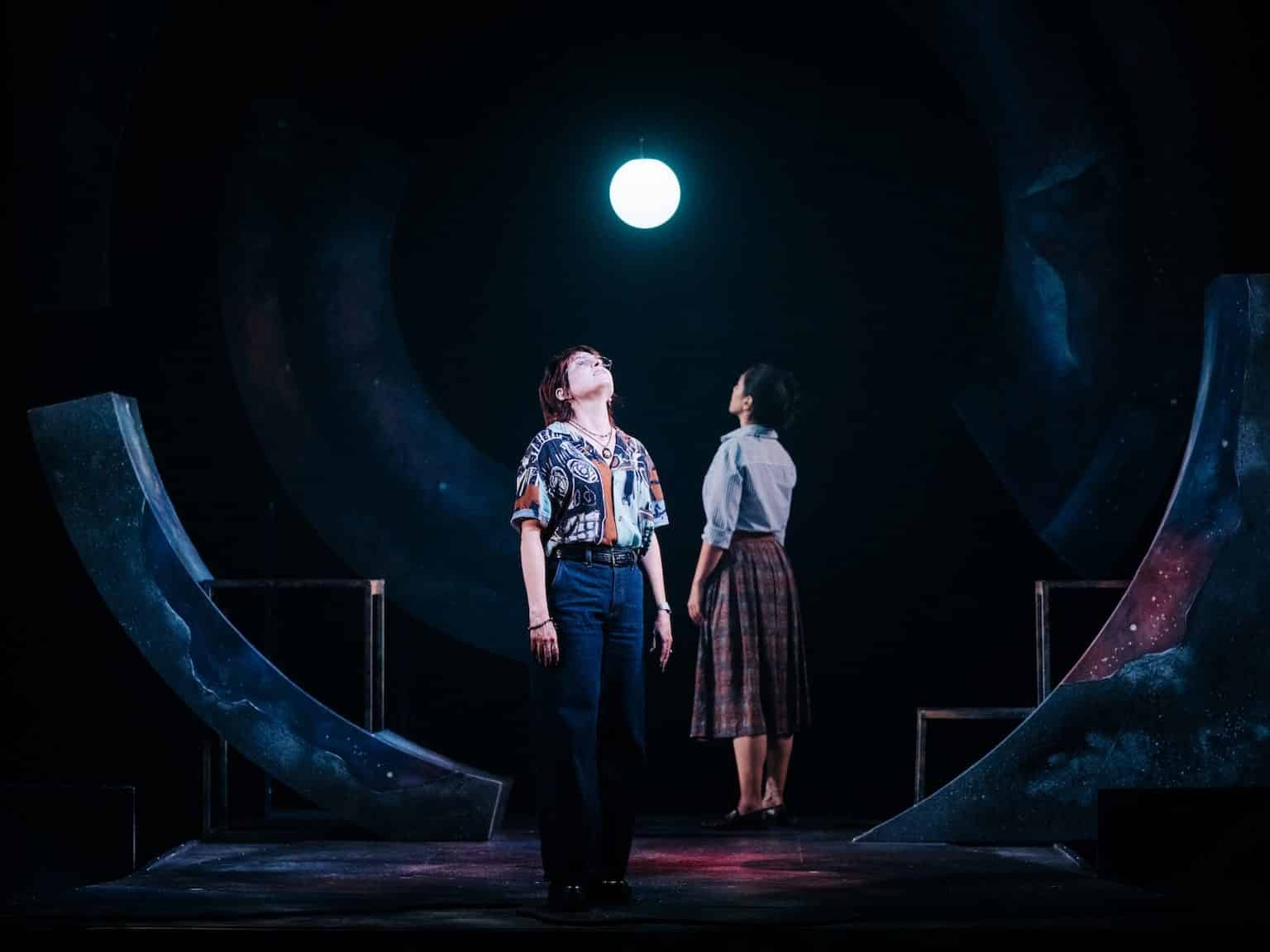
White's direction takes a second to develop, but when it does, it feels like it made sense all along. The set, a spacey wormhole designed by Gisela Estrada, is curiously framed given the apparent setting of the piece, but Yockey's dialogue is such a character on its own that one barely notices its strangeness. What helps is the superb lighting by Nic Vincent, which distances itself from the strangeness with godlike baubles of movement and highly precise spectral blocking that keep the well-earned attention on the characters (whose spunky, patterned clothes are done by Danielle Preston). The blocking of the actresses, too, is great. White smartly keeps the physicality distant despite their being trapped on a platform basically the entire show, a minimized stage encapsulating a gulf of mistreatment and understanding. 9/10
Visual Identity
The key visuals for Venus are crisply toxic, thanks to its electric green and red palette, which I found hard to grasp from the initial view but by the end of the show thought genius. The streak of red is not some random bolt of lightning, but rather the negative space between the green profiles of the two women, highlighting an intimate yet palpably distant connection. (The space represents other key plot details I won't spoil.) The maximalist lighting on the stage begets a lot of questions, mostly "Why are there so many bulbs?" -- but in tying with this nominally extraterrestrial theme, I gave it the benefit of the doubt, even if it's not quite illustrative.8/10
Overall
31/40

