

This is a continuation of Marika Keeps the Score. To read Part I: A Monumental Collaboration, click here!
Houses, Big and Small
MTDC: Between working at the pre-Broadway run of A Strange Loop, and doing a lot of smaller stuff, like Lizzie the Musical [Keegan, 2025], you've also done a lot of work at heavy hitting places like Signature Theatre. How do these experiences differ in your experience, in terms of how the work is organized and how things get spread around?
Marika: Well, working at Monumental has been, like, a one-person music department. Whereas, for example: I worked on The Bedwetter [2025] at Arena. I was the music assistant, and for that show there was: a music assistant, an associate music director, a music director, a music supervisor. Plus, of course, because it's a new show, there's an orchestrator, copyist, keyboard programmer, and Ableton programmer. A lot of people, doing a lot of things. And when I did Professor Woland, I did a lot of those things. The fact of the matter is that the smaller places can barely afford to do the shows, period, let alone have the full support that they need to maybe do a new musical at a place that has never done a musical before.
MTDC: Wait — Woland was Spooky's first musical ever? I don’t think I realized that.
Marika: Yeah.
MTDC: I’m so mad I missed that one!
Marika: Honestly, I can't believe that it was so well received, and so recognized at the Helen Hayes. Because the people who were in it were like, “Wait, what? You thought this was good?”
MTDC: Really? I remember Unprofessional Opinion or someone was raving about it, and then some of my other contacts in the industry loved it too.
Marika: I just think it was probably impressive that we were doing such a highly ambitious thing, and that it was new. And Beth [Dinkova, Artistic Director] is great, you know what I mean — Spooky is cool. I mean, we worked really fucking hard on it; I can never do what I did during that show. I was vocal arranging, sometimes orchestrating or rearranging some of the orchestrations, because it was a situation where we have a demo, but then we have an orchestrator who is not here, and then the people in the room who are also the actors are playing things — but what can they actually play, and when? It was this huge puzzle. When do we need to record stuff so that it still sounds full, but people can get up from their bass to act in a scene? It was crazy. Alec was the sound designer for that, too, and we worked together to make sure that even if someone was playing the tambourine, we made something happen.
MTDC: Would you say that was one of your biggest music direction challenges, having to pull all of that off for such a new, dynamic show?
Marika: Sure, yeah. Maybe naively, I was really excited to be doing an actor-musician show, because that's the most exciting thing to me. I love when I do the shows and I'm part of it, because acting is my background, and singing, and so I love when I can meld the two things. And so I was like, “Oh my God, I'm gonna do this thing, and there's gonna be a part of it where I don't have to be attached to the keyboard,” which was really exciting for me. It just ended up being so, so much work, because I was also like, “If I'm gonna do this, I wanna do as much as I possibly can to get it to where it can be.” Because it wasn’t that Spooky wasn't being supportive, there's just a huge learning curve to doing a musical for the first time. It's the same thing at Monumental, where it's like, we don't even own microphones. It's often me hitting up people at all the theaters that I've worked with at the bigger houses, and being like, “Hey, can I borrow microphones? Hey, can I borrow this thing? Hey, I borrowed this thing for you when I worked on that show, can I…”
MTDC: It’s important, utilizing your network. That's part of the benefit of it being such a tight-knit community, being able to utilize that for the benefit of the art form.
Marika: Totally.
MTDC: Going back to Professor Woland and all the recognition it got — taking home the Helen Hayes Award for Music Direction, how was that for you? Because I was cheering from the second tier, for real. I know a lot of people in this scene were very excited for you.
Marika: That's very nice. I just feel like I was annoyed; which is such a me thing, I have to say. [laughs] I feel like in the past, I've tried to write some things down, and then I'm like, “I'm not gonna say this.” Then the person who went before me had one of the best speeches of the whole night. It was somebody who was maybe the playwright for The American Five [Ford’s, 2025]…?
MTDC: I was going to ask — was it Chess Jakobs? His speech was awesome, a hundred percent.
Marika: Yeah. And I was like, “Okay, well, you just talked about literally everything that's important right now.” It's great, it feels great, because I feel like it's not just for that one show — it's all of the other stuff before that, that I've been working really hard on for the past however many years. But still, I was like, I feel like this is the worst I've done.
Let’s Do the Time Warp
MTDC: Which actually makes me ask: you said that you weren't a big fan of music initially, or the classes, or piano lessons or something. But, you went to school for musical theater, and now you work in music, and you still like acting. So what caused you to finally sit with music as something you enjoy doing as your career? What pushed you in that direction?
Marika: I was a children's choir kid, and I was always taking piano, but I was like, “This is kind of boring, I don't want to practice.” I would do anything to get out of practice. I would hide in the bathroom. My mom's like, “Hello, what are you doing?” “No, sorry!” Like, in my own house.
MTDC: “Occupied…”
Marika: But then — it must have been 6th, 7th, 8th grade, somewhere in there — I realized that I could play pop songs and accompany myself singing. And I thought, “Oh, that's cool,” and would put together these 7-minute-long Lady Gaga medleys.
MTDC: Release the tapes!
Marika: There's this video of me doing “Poker Face” at my 8th grade talent show at this Catholic school, and I'm like, “Why did they let me sing this?” And people were like, “Oh wow, that's so good,” you know. I was trying to decide if I was gonna go to the Catholic high school, or if I was gonna go to public school, which had a really great performing arts program and did awesome musicals. I went there, I did all the shows, and I had good parts. It was so dumb, thinking about it now: playing Orphan Annie freshman year, then sophomore year, playing Christine Daaé in Phantom of the Opera. How does that happen?
MTDC: That's a whiplash, sheesh.
Marika: Right. But listen — when I was 15, just 16 years old, I did fucking Phantom of the Opera in high school. I think it had just gotten released for high school, and mine was one of the first of however many to do it. I even got nominated for a stupid high school award that year, and I performed at the thing, and I was like, “Oh my god, this is the best thing ever.” That was my 15 minutes of fame, basically.
MTDC: Like a Jimmy Award?
Marika: Yeah, yeah, like the Jimmys. I didn't go to the actual Jimmy Awards, but the Pittsburgh version — they're called the Gene Kelly Awards in Pittsburgh. The people from Pittsburgh, from Point Park, run the Jimmy Awards, so they're modeled after them.
MTDC: Could you elaborate more on your background from Pittsburgh? I didn't realize Pittsburgh itself had such a deep theater thing. Do you ever see yourself going back there for theater, or in general, or are you really locked into DC these days?
Marika: Probably not going back there. They do have theater — I wouldn't say anywhere near, you know, Chicago or here. It’s kind of a smaller scale. They actually just had a big merger of what were almost 3 theaters, and there's a big summerstock at the Pittsburgh [Civic Light Opera] — this is their last season. I don't know what's going on, but shit is hitting the fan right now, which is kind of sad. Randomly, my church choir director was the head of the musical theater department at [Carnegie Mellon]. My mom was like, “I want my daughter to have voice lessons, will you teach her?” And he was like, “No, but I'm sure one of my colleagues will teach her.” So I started taking voice lessons with Claudia Banack there, and I did it for many years, and I think she's still there. Her family is, like, famous jazz musicians — there's a big jazz scene in Pittsburgh, too.
MTDC: You know, I think I did know that.
Marika: It's a cool place, and it's weird because — I mean, a lot of people probably relate to this — when you have not lived in a place for so long, or you haven't done something you thought you were gonna do in so long, that is like a different version of you, you know? People ask me about Pittsburgh now, and I'm like, it's cool, but I haven't lived there in 12 years. So much has changed. There's a lot of stuff I don't know.
MTDC: Of course. I am also curious how you transitioned from, A, not liking studying music, to B, now doing it anyway and making seven-minute-long Lady Gaga medleys, to then being — C — a big part of the musical theatre machine. You mentioned that's because you went to the school with a good performing arts program and did a lot of the musicals there. Music is a massive ocean of content to do or study; what brought you to DC and CUA specifically for musical theatre?
Marika: Something to keep in mind: I obviously do like music, I just didn't like practicing the piano. And I still don't like practicing the piano. [laughs] I just will do it. And my high school had great performing arts, but was not a “performing arts” high school. And so I did fucking everything: I was in marching band, sometimes I would play in jazz band when they would let me, and I was in choir. I also swam all year round. I was crazy. There was a long time where I was like, “I'm gonna be a marine biologist, just like everybody else” — but I don't know. After 2-3 years of doing the shows, I was like, "Oh, maybe I'll do musical theater, it seems like I'm good at that here." I went to a summer program in New York called ArtsBridge, where they bring faculty from a bunch of the different top schools. At the end, if you want, they will help coach you — not acting-wise, more career — they help you with applications, and they're like, here's a list of schools that you maybe don't know of, that's not, like, the Rider, NYU, Carnegie Mellon, whatever. I applied to a million schools — it definitely felt like I auditioned at a million schools. When it came to the springtime, the two schools that I was between were AU [American University] and Catholic. And I was like, well, “I guess I'm going to DC”. I didn't necessarily seek them out — someone gave them to me on a list, and then I looked into them, and I was like, “Oh, okay, cool, DC seems cool.” I had never gone there before my auditions, because I didn't have an 8th grade DC trip or anything like that. I ended up picking Catholic because they offered a BM [Bachelor’s of Music] rather than a BA, so I'll get more emphasis on the music. That sounded like a good idea.
MTDC: Sounds like it was fate.
Marika: I guess so. In terms of getting from that to doing music directing, it was a lot of people asking, “Hey, will you play my song for me?” I didn't realize people couldn't read music, period. I realized: “Oh — I have leverage. I have something, and people want it.” But also, it was kind of sad, because some of my professors would just assume that “Marika's gonna assistant music direct for me,” and they'd use me as free labor as a rehearsal pianist, and then never cast me in shows. I finally got cast senior year, and they're like, “Wait, you're really good.” I was like, “Yeah: and I've been here the whole time. You decided to do this!”
MTDC: I'm thinking of the scene from— what is it, Camp Rock? The Disney Channel film, “Wait, she’s really good!” like that.
Marika: Oh, yeah. It’s like, “Why are you shocked? This is why I came here.”
MTDC: That's a fun story. I'm glad that they finally recognized you. It seemed like it took a long time — senior year!
Marika: Dude, I think they just felt bad, and then by chance they were like, “Oh wait…”.
MTDC: I feel like it would have happened sooner or later. They really can't keep you tied down like that — or typecast, so to speak, as a rehearsal pianist.
Marika: Oh yeah. I'm just — what's her name from High School Musical — Kelsi.
Behind the Keys
MTDC: Okay, a bit of a pivot: I understand you're Greek — or you're from Greece, or family's from there…
Marika: Oh yeah, I am Greek. I'm also Italian, but yes, I'm Greek.
MTDC: You’ve also said in the past that you go to Greece a lot. If I've never been to Greece, what should I do?
Marika: Hmm, what should you do? Okay, well…
MTDC: Feel free to gatekeep.
Marika: [laughs] No, no, definitely not. So my family is from the island of Kefalonia, which is on the Ionian side, which is the most beautiful island — at least, says my family. But then I meet people from other islands, and they are like, “Oh, you're lucky.”
MTDC: I’m booking my flight as we speak.
Marika: Yeah, Kefalonia. You should go there. Don't go to Mykonos — it's like the Disney World of Greece. [laughs]
MTDC: That's what I've heard. I didn't necessarily plan on going to Mykonos — but I also didn't necessarily plan on going to Greece anytime soon in the first place. I was just like, “Oh, if anyone would know anything about Greece, it would probably be the person who says they go to Greece a lot.” I do a lot of traveling, but mostly because of exchange students I've worked with, but none of them were Greek.
Marika: Well, they invented theater, you know.
MTDC: Hence the name, thespian, yeah. What else is cool about you, besides anything theatery?
Marika: I'm in a cover band.
MTDC: A cover band! What's this cover band called? Where can we watch you?
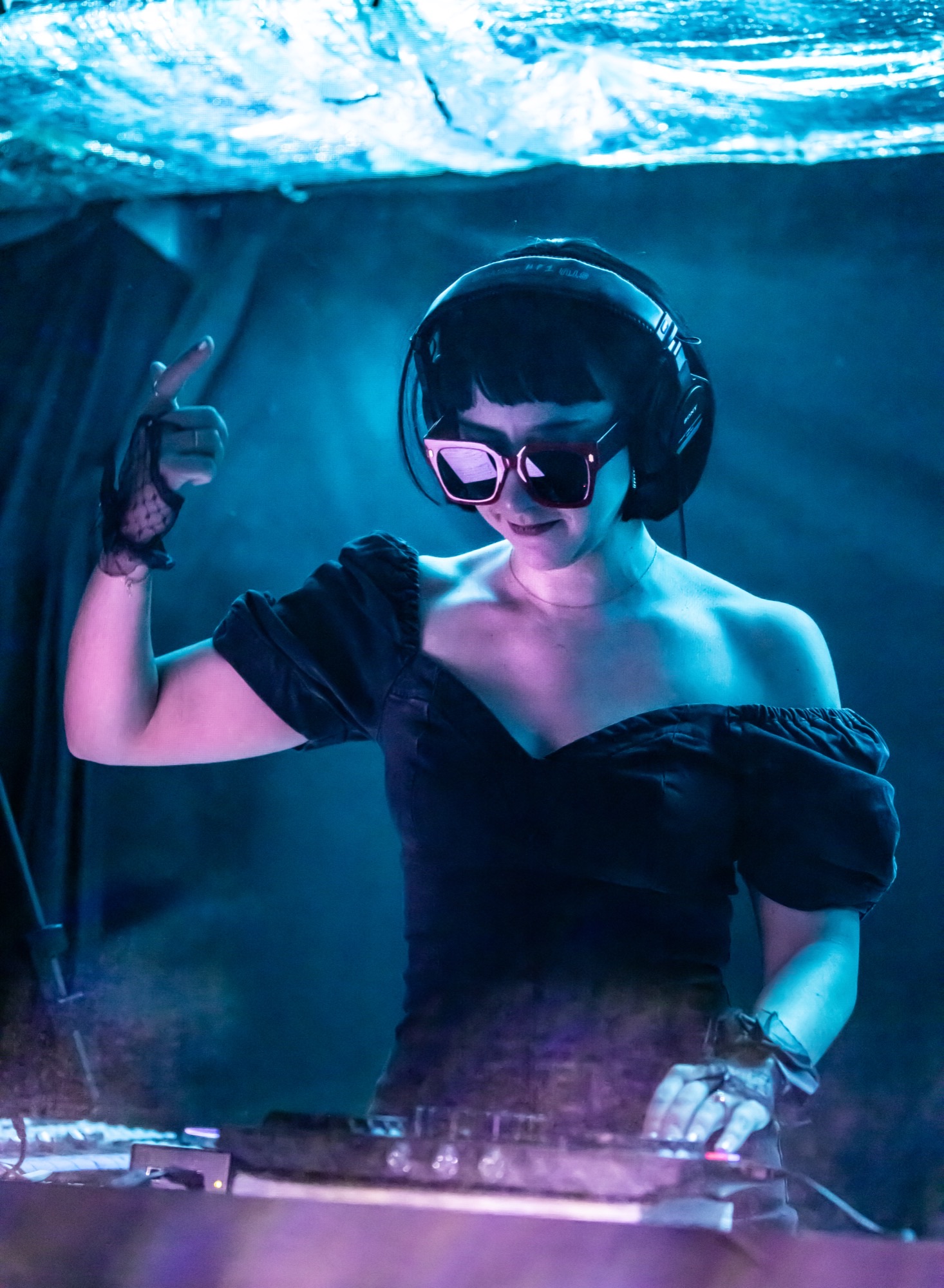
Marika: It’s called Scrumptious, the band — I think that's Instagram, too. [Links following the interview.] Usually we play in Baltimore. Just kind of bar gig vibes, which is fun, because with music directing being my whole thing, it's hard to find outlets to do music for fun, just for me. I feel like I wasn't doing a ton of singing in public unless it was for a show, or a church gig, so it's been really fun to do something for me, and go scream Paramore in the bar. It's cool — my husband Sam [Carolla] is the drummer, my friends Oliver [Dyer] - guitarist, and Matthew [Borzymowski] - bassist, both sing as well! We all do music in other areas of our lives, and a bunch of us have played musicals together before, but we also are in bands, which I think is what gives us an edge whenever we're playing a rock musical together: because we actually go out and do that for real.
MTDC: Are you based in Baltimore?
Marika: No, it's just that two of our band members are more towards there, so that's just where they get the gigs.
MTDC: Baltimore's a good spot for some DIY music. I know a few bands who play up there a lot too.
“A Big Finale”
MTDC: I guess my last question is: how do you feel about the state of DC theater these days?
Marika: Oh… this is a big finale.
MTDC: Yeah. [laughs] What's something you would do to improve it or change it somehow? I have a feeling — I remember your speech at the Helen Hayes — but whatever it is, I want to hear it from you.
Marika: Well: I just don't get it. There's just so many women in the industry, especially musicians. Like, dude, there was one girl in the pit of [a recent major DC musical]. Out of how many people?
MTDC: Wow.
Marika: I'm not trying to get in trouble with the contractors of DC, you know? But it’s so hard — the contractors are essentially casting directors for the musicians of these theaters, but there’s no open call or way to “submit.” And they're all middle-aged-plus white men.
MTDC: Interesting.
Marika: It's a very interesting thing to navigate. They're all great people, but they've got their dudes, so it's really hard to break in. I feel really lucky that I've gotten to work at places like Signature, for example, and bring in new folks — people who are younger, people of color, women. I'm pretty sure that the one night that I was conducting Safety Not Guaranteed, and we had myself on keys 1, Lucia [LaNave] on keys 2, and Joanna [Smith] on bass — so three women, two men — was the first time that there was a majority-female pit in the Max theater, the bigger theater at Signature. I don't think that's ever happened before. That’s why I’m super excited that my next project, Adam Gwon’s All the World’s a Stage, will be a majority-female pit.
MTDC: That’s exciting — but that was the first time in the Max, ever?!
Marika: I was thinking about it before the show started, and I got on the little comm and I asked Kerry [Epstein, Stage Manager], who has been there for 20 years now — I was like, “Hey, I might be crazy, but do you think this is true?” and she replied, “I unfortunately think you're right. There's been a couple times in the Ark — like when they did Girlfriend, there was an all-female band, and when they did Penelope [2024], it was majority female except for the music director [Ben Moss]— but I don't think it's ever happened in the Max.”
MTDC: That's literally crazy — that the one time you conducted for a recent show was the first time ever for a majority-women pit in that space. That's baffling to think about.
Marika: Yeah, and a similar thing — I don't know if you know, recent AU grad Daniela [Ignacio] — she does a couple blog things, and wrote a piece reflecting on the Helen Hayes Awards this year.
MTDC: Oh, yes, and it broke it down by gender, I believe.
Marika: Yeah, and it talked about the music direction, and that the last time it was won by a woman was for Girlfriend at Signature, which was in 2017 or 2018, I think; that was the first time. [See Editor’s Note below]
MTDC: Wow. Interesting.
Marika: So there's only been two of us.
MTDC: To ever win that award!
Marika: That was what she said in that article. I was like, “That's crazy!”
MTDC: That's really nuts.
Marika: It is hard to fucking get in places, and especially it's hard to get in places as a leader. Do you follow Katie Spelman? She's a director-choreographer in New York and Chicago. She's going to be directing Urinetown at Signature this year. She runs this Instagram account called, like, “Agnes Index” or whatever, and when a Broadway show opens, she'll post the positions and a breakdown of gender.
She puts these things out, and, during the Tony Awards, kind of a wrap of that demographic breakdown. And behold, every category is majority male, majority male, majority male — until you get to the associates. Then the associates are majority female.
MTDC: Ouch.
Marika: It's just like — dudes would be nothing without their female associates. As someone who has worked under male music directors and male music supervisors — some experiences of which have been great, others not, for one reason or another — just kind of being like, “Okay, how long do I have to pay my dues?” I know that there's other associates in this town who feel the same. Why does it feel that someone has to take a chance on us, or they decide when we're ready? You're not ready until you just do it. I don’t know.
MTDC: That sounds like you do know. It's all true. It's all real.
Marika: I'm just tired. I'm just tired of seeing the same people doing stuff all the time. But one day, people will be tired of me.
-
[I laughed repeatedly during this interview. Marika is very funny.]
Editor’s Note: Karen Hansen was the first woman to receive the Helen Hayes Award for Music Direction for Moxie: A Happenstance Vaudeville in 2017. Britt Bonney was the second, winning for Girlfriend in 2019. Marika’s win in 2026 makes her only the third in the entire 43-year history of the awards. To date, no woman has won the award in the Hayes category. (Source)
To learn more about Marika’s work, cover band, and more, check out the links below:
Website - marikaannecountouris.com
Scrumptious, the band - instagram.com/scrumptious_band
For more on Signature’s All the World’s a Stage and to buy tickets - sigtheatre.org/shows-and-events/all-events/2026-2027/all-the-worlds-a-stage